What changed before a competitor overtook your VS Code extension?
Investigate a VS Code extension rank drop by checking repeated searches, competitor edits, and releases before changing your own listing.

Builds VSXRank · 7 min read

TL;DR: If a competitor moves ahead of your extension, first check that the change lasts beyond a few readings. Then compare both listings' edits, releases, and search positions over the same dates. Often there is no visible edit to explain the move. Keep a record before deciding whether your own listing needs a change.
Your VS Code extension rank dropped: what to check first#
A small drop can be a normal reshuffle in search results. Before changing your listing, repeat the search and check whether the new position holds.
We measured this variation on 5 September 2026 by running the same Marketplace searches twice, 25 minutes apart:
| Search positions | Typical movement between repeated searches |
|---|---|
| 1–10 | ±0.4 |
| 11–50 | ±2.4 |
| 51–100 | ±4.1 |
| 101–300 | ±7.5 |
| 301+ | ±19.5 |
Results farther down moved more. A change from #140 to #146 fits within the variation we saw for that group; a change from #22 to #825 is much larger.
Use the repeated readings for your actual search when they are available. The table is a dated example, not a fixed rule for every search. Our ranking guide covers a separate three-sample study from 8 September; its statistics differ, so the two tables should not be used as interchangeable alert thresholds.
Check whether the move lasts#
Even near the top, neighbors can swap places from day to day. For theme, Dracula and One Dark exchanged #5 and #6 eight times between 5 and 22 September, with no recorded listing changes.
We also reviewed top-ten passes between 7 and 20 September. There were 302 cases where an extension was behind another for two days and ahead for the next three. Only 17 remained when we required a gain of at least two positions, three days behind beforehand, and no later reversal in the observed period. Most of the others were one-place swaps.
If the change is small or quickly reverses, another few readings may be more useful than an immediate edit.
Look at your other search terms#
Check whether the move happened for one phrase or several. A single search can show only part of the picture.
On 16 September, Microsoft Edge Tools for VS Code removed ten language tags, including html, json, typescriptreact, and sass. Around the same time:
debuggersimproved from #17 to #9 and stayed there through 22 September, passing Docker and a Salesforce extension.typescriptreact(#10),javascriptreact(#9),jsonc(#11), and six other searches matching removed tags left the first 1,000 results.htmlmoved from #465 to #515.
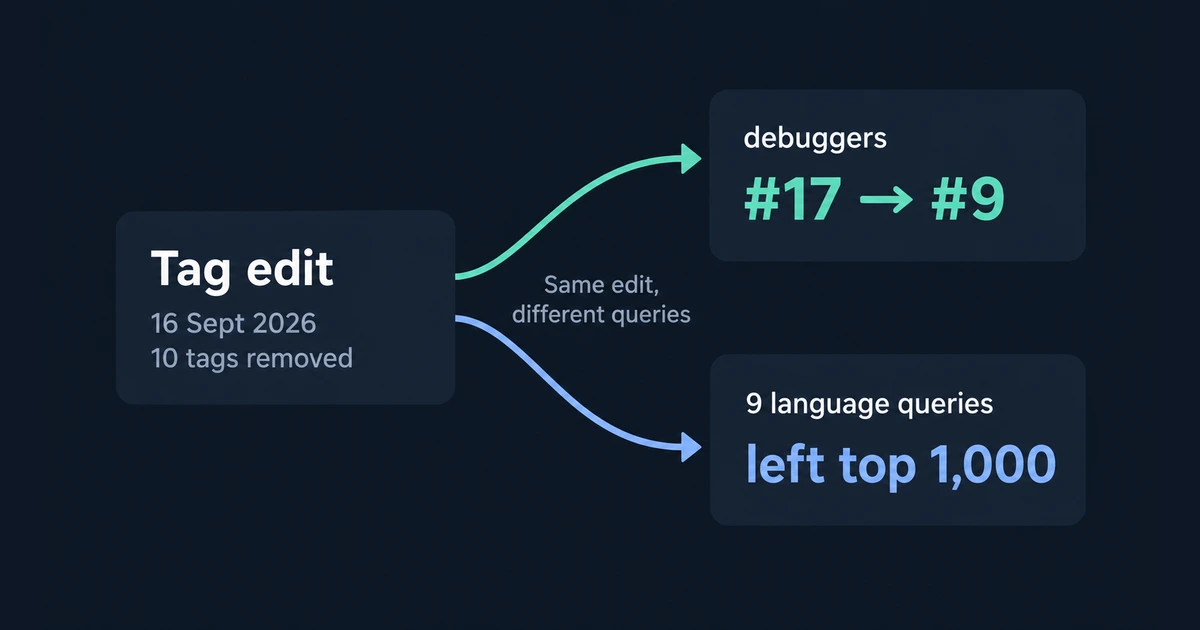
Someone watching only debuggers would see an improvement. Someone watching typescriptreact would see a disappearance. The extension also released an update on 15 September, so the tag edit was not the only change in that period.
Compare changes on both listings#
Choose a period to review, such as the three days before the move through the day it appeared. For your extension and the competitor, check:
- Words added to or removed from the display name.
- Changes to tags and the short description.
- Category or publisher-name changes.
- Releases and their dates.
- New extensions that entered above either listing.
Microsoft's manifest reference describes the name and description as text-search fields and allows up to 30 keywords, which become tags. Its search documentation lists sorting options, but it does not publish the default ranking formula.
Your notes can show what changed near the move. They cannot reveal exactly how the Marketplace used each change.
It is common to find no visible edit. Of the 17 lasting top-ten passes in our sample, 11 had no recorded edit or release on either extension in the three days before the move. Two had releases only. Four had listing edits: three involved our own extension's 14 September rename, and one involved Edge Tools.
If the record is empty, note that too. There may be no clear reason to edit your listing yet.
Check installs and ratings over the same dates#
Counts can add context, but a higher install total does not always mean a higher search position. On 19 September, Dracula had about 10.96 million installs compared with One Dark's 7.34 million, yet it ranked one place behind on 12 of the 18 days we checked.
Compare both extensions over matching dates and use several days of readings. Marketplace counts can sometimes fall, so one day's change is a weak basis for judging growth. If you also use Open VSX, keep its download count separate; our download-count guide explains why.
Keep a short investigation record#
A repeatable checklist makes the next drop easier to investigate:
- Write down the search phrase, registry, and last normal position.
- Compare the move with the variation in repeated searches.
- Check at least three more daily readings to see whether it lasts.
- Review your other tracked phrases over the same dates.
- Record edits, releases, nearby new listings, and count changes for both extensions.
- Describe what happened using dates, then decide whether to edit or keep watching.
If you make an edit, change one thing and record the date. That makes the next comparison easier to interpret.
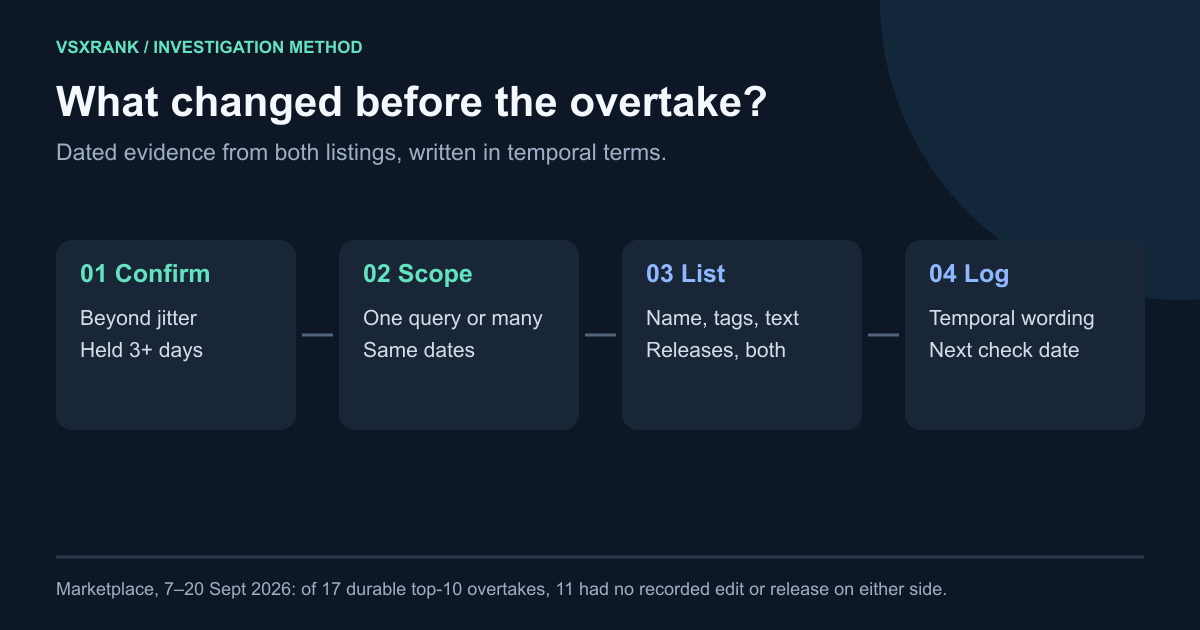
You can use this template. “Band” means the range of normal variation you observed; “D-3 to D” means the three days before the move through the day it appeared.
Query:            ______________________   Registry: Marketplace
Your extension:   publisher.name ________   Competitor: publisher.name ________
Last normal day:  YYYY-MM-DD  position #___ (band ±___)
First moved day:  YYYY-MM-DD  position #___   Stayed there through: YYYY-MM-DD
Other queries:    ___ moved the same way, ___ unchanged, ___ opposite

Window (D-3 to D):  Yours                      Competitor
  Display name      ________________________   ________________________
  Tags +/-          ________________________   ________________________
  Description       ________________________   ________________________
  Categories        ________________________   ________________________
  Releases          ________________________   ________________________
  Installs/ratings  ________________________   ________________________
  New entrants above: ______________________

What changed, and when:
  "In the same window as ____, position moved from #__ to #__ and held for __ days."
Next observation date: YYYY-MM-DD
What we saw after listing edits#
For readers who want the wider dataset, we reviewed Marketplace listing edits recorded from 6 to 19 September. We looked at tracked searches whose words were added or removed, then compared the reading before the edit with up to eight later daily readings available by 22 September. Every edit had at least four later readings.
We counted a move as lasting when at least three quarters of those later readings were beyond the normal variation for the starting position. Leaving the first 1,000 results counted as a worse position.
Each “query pair” below is one extension matched with one search phrase. These rows cover pairs that already had a rank before the edit:
| Marketplace edit | Extension/search pairs | Improved | No lasting move | Worse or missing |
|---|---|---|---|---|
| Query words added to display name | 21 | 15 | 5 | 1 |
| Query words removed from display name | 25 | 1 | 1 | 23 |
| Query added as a tag | 1,040 | 388 | 595 | 57 |
| Query removed as a tag | 73 | 1 | 8 | 64 |
| Query words added to description only | 507 | 158 | 332 | 17 |
| Query words removed from description | 110 | 2 | 15 | 93 |
| No recorded listing edit (13–21 Sept baseline) | 173,409 | 5,590 | — | 10,609 |
Across listings without a recorded edit, 3.2% of positions improved and 6.1% worsened over the 13–21 September comparison period. Later edits had fewer follow-up days, so their rates are not directly comparable with that group.
We also checked pairs starting outside the first 1,000 results. After search words were added to the display name, 36 of 58 entered the results. The figures were 376 of 1,744 for added tags and 259 of 2,242 for additions only to the description.
These patterns have limits. One edit can affect several phrases, and a release can change several listing fields together. The name-edit groups are small. The results show what followed the edits, but they do not isolate the effect of a single field.
Four examples from the record#
- Light removed:
lninl.theme-hbuilderx-soft-green-lightwas #22 forlight themebefore the edit recorded on 10 September, then #815–#849 for the next eight days. - Secrets added:
Arcane-Spark.ubel-vscodemoved from #232 to #34–#35 forsecretsafter the edit recorded on 13 September. It also removedsecurityand left the first 1,000 results for that word. - Name changed:
pandaprog.claude-agentsbecame “Claude Agent Map & Usage” on 16 September. It moved from #452 to #62 forclaude usage, whileagentschanged from #21 to about #220. - REST added, little movement:
salilvnair.daakiaadded “REST” on 14 September and moved from #80 to #79–#80.
The live demo shows rank history, competitor positions, releases, and listing edits together so you can follow the same process on a real extension.