VS Code Marketplace search ranking: measuring jitter and real movement
Learn how VS Code Marketplace search ranking varies between identical searches, how to filter jitter, and which listing fields to review.

Builds VSXRank · 6 min read

VS Code Marketplace search ranking is an observation, not a permanent score. Repeat the same search minutes apart and an extension can appear in slightly different positions even when its listing has not changed. That variation grows deeper in the results. A useful rank tracker therefore needs repeated samples, the range around the reported position, and enough history to separate a reshuffle from a sustained move.
What VS Code Marketplace search ranking does—and does not—tell you#
Microsoft documents the listing fields publishers can control. The extension manifest defines the displayName, short description, categories, and up to 30 keywords; those keywords become Marketplace tags. Microsoft also says the display name and description are used for text search, and recommends relevant terms in both (Extension Manifest).
Microsoft does not publish a weighting formula for the default order. Its user documentation lists explicit sorts for installs, name, publish date, rating, and update date, separately from ordinary search (Extension Marketplace). That makes one boundary important: an observed position tells you what the Marketplace returned for a query at a time. It does not reveal why the ranker put an extension there.
Rank is also query-specific. Being #8 for code history viewer says nothing about the same extension's position for claude code. Track phrases that describe the extension's job, integrations, and product name rather than treating one broad category term as an overall score.
What repeated Marketplace searches showed#
On 8 September 2026, we measured 110,484 Marketplace positions across three identical samples taken minutes apart. For each extension and query, the range is the highest position minus the lowest position in those three results.
| Position band | Positions measured | Average three-sample range | Widest range observed |
|---|---|---|---|
| 1–10 | 1,201 | 0.0 | 3 |
| 11–50 | 4,763 | 0.4 | 31 |
| 51–200 | 17,845 | 1.0 | 62 |
| 201 and deeper | 86,675 | 2.2 | 200 |
The averages show the main pattern: the first ten positions were effectively stable, while the typical spread increased farther down. The maximums matter too. Averages are not guarantees, and a universal rule such as “every move under five places is noise” would hide some real changes while failing to cover some reshuffles.
One earlier probe makes the effect concrete. Five identical searches for claude history returned the same first nine extensions each time. The extension we were checking appeared at #11 twice and #12 three times. Nothing in its listing changed during the probe. We observed two orders from the same request; we did not identify the mechanism that selected between them.
These measurements describe those samples and dates. They are a baseline for interpreting later readings, not a specification of the Marketplace search system. The sample positions in the sampling diagram are an illustration of median sampling, not another measurement.
Why one rank reading is not enough#
VSXRank takes three Marketplace samples for a tracked keyword and reports the median. It also keeps the minimum, maximum, number of samples in which the extension appeared, and total results returned for the query.
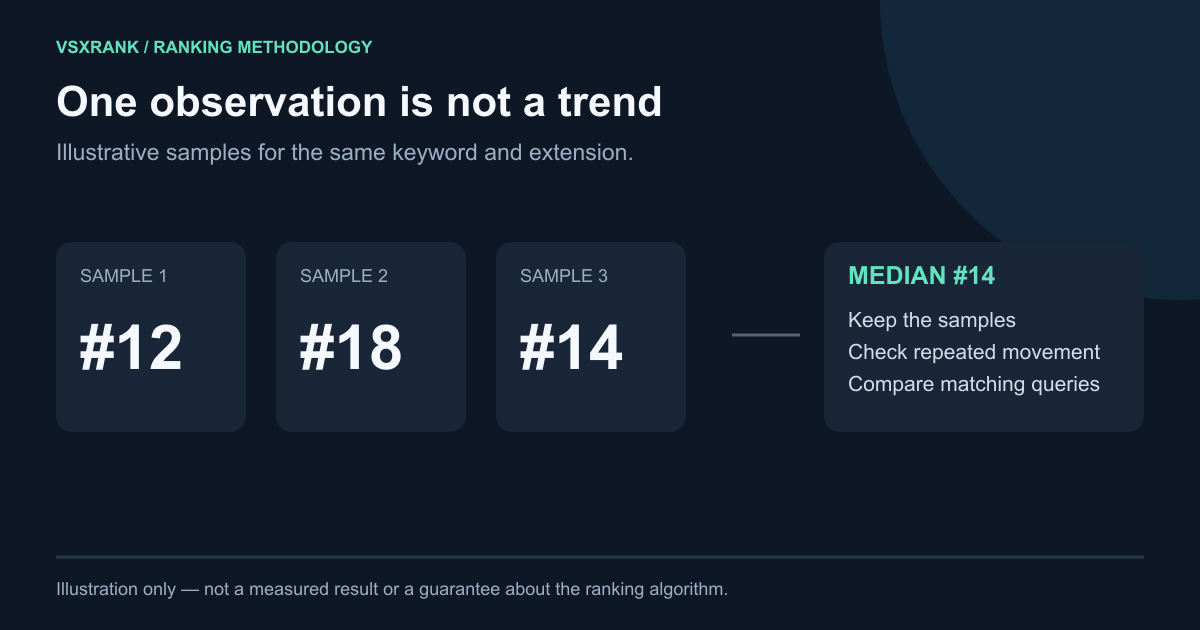
For positions 11, 12, 12, the median is #12 and the observed range is #11–#12. If tomorrow's samples are 12, 12, 13, a change from median #12 to #12 is clearly nothing. If they are 18, 19, 19, the two sample bands no longer overlap, which is more useful evidence than either day's middle number alone.
A missing observation needs special treatment. If an extension appears in only two of three samples, the median uses the two positions we actually saw, but it is optimistic: the absent sample may place the extension outside the 1,000-result window. Treat that day as incomplete rather than assigning position 1,001.
Total results add context, but they are not a measure of audience interest. Position #40 among 80 returned matches and #40 among 40,000 returned matches are different competitive settings. Neither number tells you how many people typed the query or installed from it.
For deeper positions, sampling depth matters as much as sampling frequency. On 5 September 2026, agsoft.claude-history-viewer appeared at #292 of 37,861 results for claude code. A tracker capped at 100 would record no position even though the extension was present. Why VSXRank tracks the first 1,000 results explains that tradeoff.
Which listing fields are worth reviewing#
Our 13 September study covered 221 Marketplace searches. We tested whether every meaningful word in each search appeared in an extension's display name. The overlap was much more common near the top:
| Result group | Rows with every search word in the display name |
|---|---|
| Positions 1–10 | 88% |
| Positions 301 and deeper | 28% |
Exact tag and description matches were broadly flat across those bands. This is an association in one dataset, not a recovered ranking formula. Strong listings may earn both better positions and clearer names for other reasons, and the Marketplace can change its system.
Two listing histories from the same study are useful case notes:
lninl.theme-hbuilderx-soft-green-lightremoved “Light” from its display name, while the word remained in its tags and description. Its observed position forlight themewas #22 before the edit and #825 the next day.Arcane-Spark.ubel-vscodeadded “Secrets” to its display name. Its observed position moved from #232 to #34 for the tracked search the next day.
The timing makes both edits worth investigating. Two examples cannot isolate the edit from every other input to the Marketplace, so they do not prove that another publisher will see the same result.
Use the evidence as a review order. First, check whether a reader can understand the extension's specific job from its display name and description. Then add accurate manifest keywords and categories. Microsoft says keywords make an extension easier to find and categories improve filtering and discovery (Extension Manifest). Keep the wording natural and accurate; repeated terms do not become more relevant merely through repetition.
A practical workflow for publishers#
- Choose five to ten specific searches that match real use cases: the tool or framework, the task, and a phrase containing your product name.
- Record at least three results per Marketplace search, including the median, minimum, maximum, missing samples, and total results. Track Open VSX separately because it is a different registry.
- Before reacting to a daily move, compare the two days' sample ranges. Give more weight to a move that persists across later crawls than to a single displaced result.
- When a sustained move appears, review dated listing changes and nearby competitors. Treat releases, renames, description edits, and new entrants as context to investigate.
- If important query words are absent from the display name, decide whether adding them would make the name clearer to a person. Do not sacrifice identity or readability for an unverified theory about the ranker.
- After an edit, preserve the before-and-after samples and annotate the date. Avoid changing several listing fields again before you have enough observations to interpret the first edit.
The live demo shows the same median rank, sample range, total-result context, and competitor view used in a tracked watchlist. Use those together; a bare position is the least informative version of the data.