How many VS Code extensions are there? The September 2026 catalogs
A 6 September 2026 snapshot counted 115,150 Marketplace listings and 17,429 on Open VSX. See the overlap, method, and limits.

Builds VSXRank · 3 min read

TL;DR: On 6 September 2026, VSXRank counted 115,150 extensions on the VS Code Marketplace and 17,429 on Open VSX. We found 13,461 matching extension IDs on both. These are counts of listings on that date. They help you check where extensions are published, but they do not measure how many people use either registry.
The two catalogs, side by side#
The Marketplace and Open VSX each have their own extension catalog. We checked both on 6 September 2026 and matched listings by publisher.name, the extension's ID.
| Measure | VS Code Marketplace | Open VSX |
|---|---|---|
| Listed extensions | 115,150 | 17,429 |
| Published in the last 30 days | 3,401 | 1,114 |
| Published in the last 7 days | 734 | 293 |
Present on both registries (same publisher.name) | 13,461 | 13,461 |
| Only on this registry in the snapshot | 101,689 | 3,968 |
| Open VSX-only listings published in the last 30 days | — | 312 |
| IDs on both registries with a publication date in the last 30 days | 567 | 567 |
Over the 30-day period, the Marketplace recorded an average of about 113 published listings per day, compared with 37 on Open VSX. Those are averages across the period, so the number on any one day may have been different.
The 567 matching IDs in the last row had a publication date within the period and appeared in both catalogs. That does not tell us whether their uploads happened together or whether they were first releases.
How much do the catalogs overlap?#
About 77.23% of the Open VSX catalog also appeared on the Marketplace under the same ID. Looking from the other direction, 11.69% of Marketplace listings had an Open VSX match.
The remaining 3,968 Open VSX listings made up 22.77% of its catalog. Counting each matching ID only once gives 119,118 listings across the two registries.
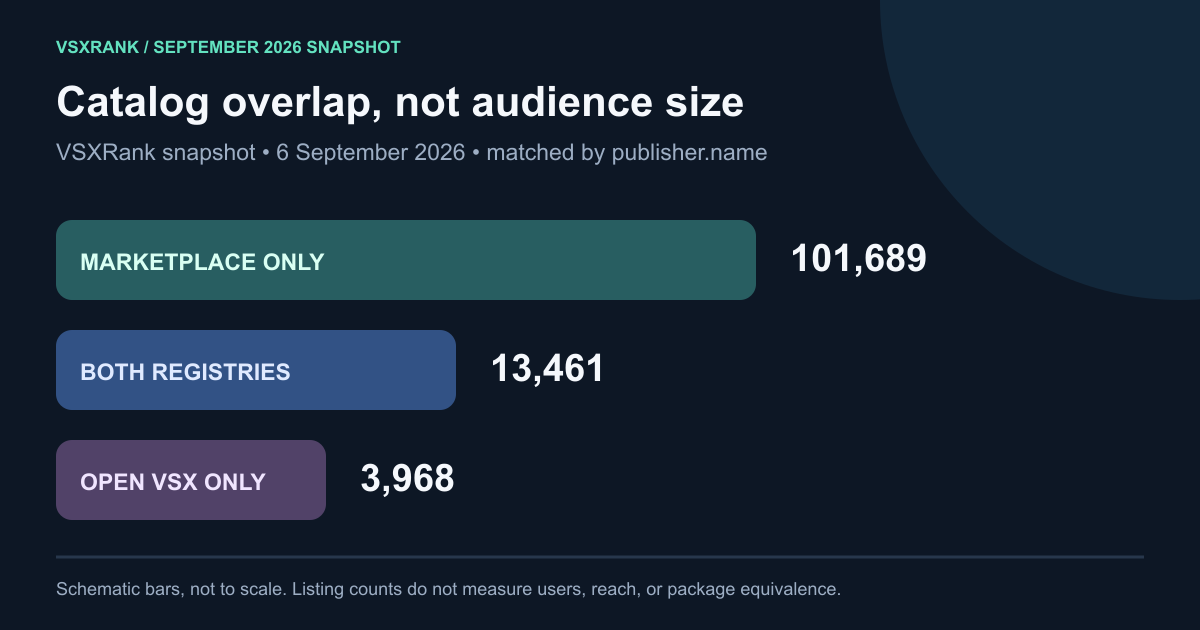
| Where the ID appears | Listings | Calculation |
|---|---|---|
| Marketplace only | 101,689 | 115,150 − 13,461 |
| Matched on both | 13,461 | Same publisher.name in each snapshot |
| Open VSX only | 3,968 | 17,429 − 13,461 |
| Total, counting each matching ID once | 119,118 | 101,689 + 13,461 + 3,968 |
The counts show where listings appeared. Whether it is worth publishing your extension on both registries depends on the editors you want to support and the releases you can maintain.
VS Code's documentation describes the Marketplace as its extension source. The Open VSX CLI documentation describes publishing and downloading through Open VSX.
What to check for your own extension#
- Look up the exact
publisher.nameon each registry. - Check the version, project link, licence, and support links on each listing.
- If one listing is missing, decide whether you want to support that registry and keep it updated.
- If you publish to both, compare each registry's counts and search positions separately, using matching dates.
Marketplace installs and Open VSX downloads measure different things. The download-count guide explains how to read them. Missing readings should stay marked as missing rather than being filled with guessed values.
How we counted, and what the count leaves out#
VSXRank read the public catalogs on 6 September and compared normalized publisher.name IDs. That matches the publisher-and-extension naming pattern used by both registries.
This method has a few limits:
- The same ID is a match between listings. It does not prove that the owner, package, version, or support policy is the same.
- Different IDs do not match. Related projects published under different names remain separate in this count.
- A missing listing is missing from this snapshot. The package might still be available through another source or a private registry.
- Publication dates describe registry records. They do not tell us how many people adopted an extension or why a publisher chose that registry.
Use the report to find listings worth checking. For a specific extension, opening both pages and reviewing the versions will tell you more than the size of either catalog alone.
Subscribe to the occasional VSXRank digest for future catalog reports and notable extension changes.